Friday, December 24, 2010
"A Long Journey to Hope"- blog by Steve Reynolds, True Spirit of Christmas Team Leader
Introduction by Mindy:
One of my favorite movies growing up was Back to the Future. I used to love watching Michael J. Fox jump into that flashy time machine car and whiz off down the street as he suddenly flashed into another year in history...or the future. It always made me wonder…what if I could do that?! What year would I want to go to?
This week in Africa, there have been days I’ve wished I had a time machine so I could leap back in time to see what life was like before World Vision had a presence here. Yes, I’ve met children who greet me smiling, happy and healthy. Yes, the animals they’ve received mean they are no longer starving. And yes, their parents say they are more successful than they’ve ever been.
I’ve only been an employee with World Vision less than a few months so I’ll admit… as the newbie to rural economic development …I have struggled this week to not judge too quickly “success” from a touristy American’s perspective. Some of the children I’ve met this week didn’t have shoes on or didn’t have a front door on their mud constructed home. One boy had to make his own soccer ball. Another girl had a rudimentary bandage on her recently sliced finger. And most, you could tell had never been to a modern dentist.
Should I feel happy for their ‘success’? Or disappointed?
My questions are probably too complicated to answer during this brief, 14-day journey through Africa, but I do feel as if I’ve had a sort-of ‘time machine’ with me this trip helping me out.
Steve Reynolds, a 27-year veteran of World Vision, has been our guide so far and remembers what Africa was like decades ago when he first started working here. I’ve peppered him with questions nearly every day asking him what life was like then. I encourage you to read his blog as it gives us a rare perspective on ‘success’ in rural economies…a perspective that starts by taking us back in time.
A Long Journey to Hope Steve Reynolds
The memories come flooding back to me whether I want them to or not. They are just mental images now: snapshots, really. But they are as clear now as they were 26 years ago. I can't forget the faces. Tiny eyes looking up at me through the lens of my camera. Eyes which I could swear had given up hope of ever looking happy again. In a way, I don't ever want to forget them - if for no other reason than to remind me of just how bad things can get. The year was 1984, and I was standing in a dusty dry village in northern Tanzania. I had just left Ethiopia where the greatest Famine of the 20th century was already claiming hundreds of thousands of lives. I watched helplessly as the same killer drought ravaged countires further south.
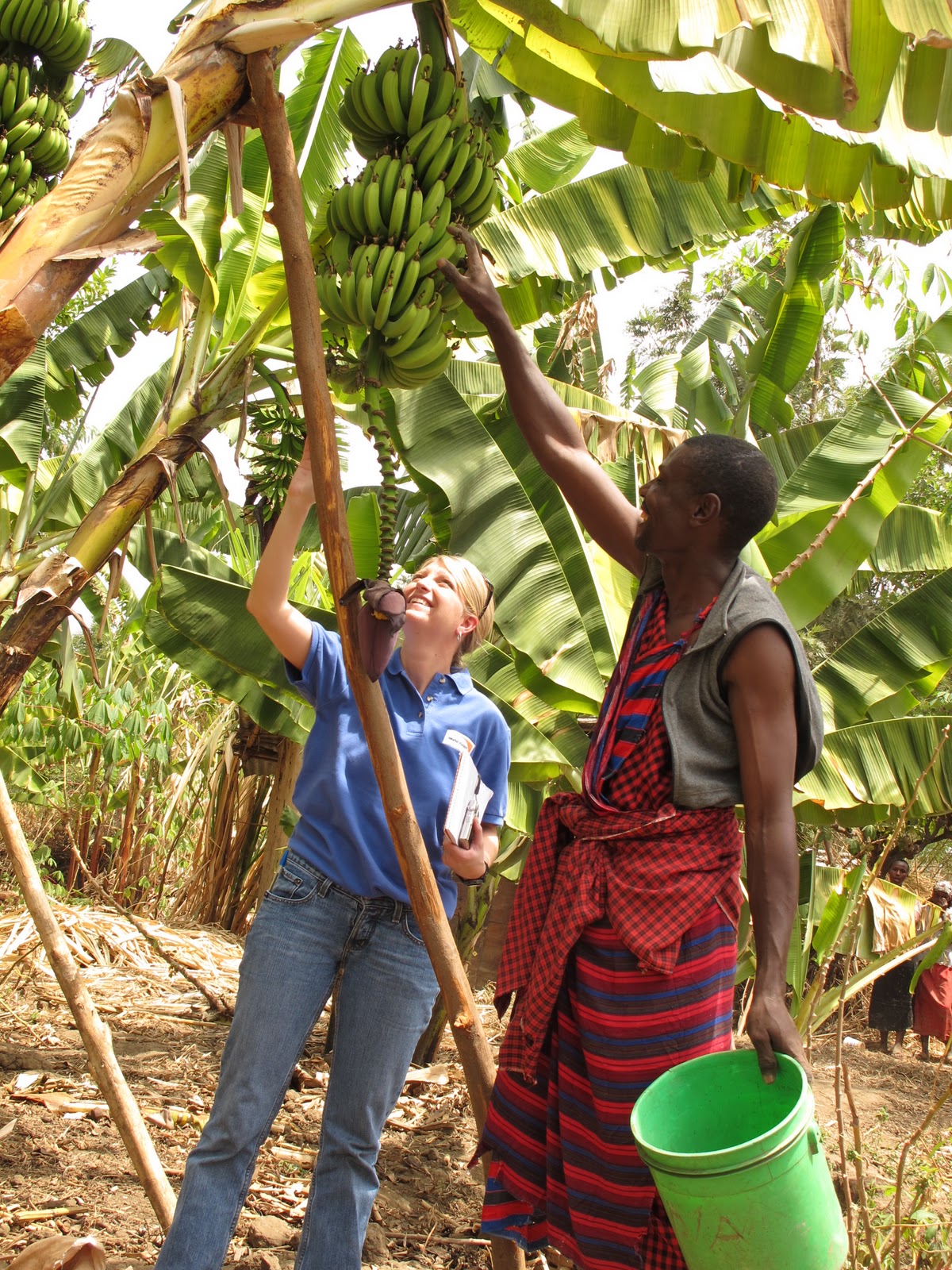
Fast forward the tape to this past Tuesday. I'm standing in another village in the same part of Tanzania. It's a lot greener now than it was then, but otherwise it looks the same. Only this time, instead of photographing emaciated bodies and children too weak from malnutrition to keep the flies from their faces, I'm watching a father help his son and daughter pull a net through a fish pond. I stand there watching as they expertly drag the net along the bottom with one hand, while holding the other end above the surface. I am skeptical. Maybe they'll get a few frogs ,I thought. Then, with a skill and adeptness that only comes from a lot of practice, they lilft up the net and inside are literally hundreds of small "fishlings" each one about four inches long. They don't eat these fish, they sell them, and earn cash to buy food, clothing, and pay their children's school fees. They also use the cash to buy banana seedlings, the excess produce of which they also sell. "As you can see," says Michael Shirima, the father, "my daughters are fat enough because they have lots of nutritious food to eat." He smiles and the girls giggle. I nearly cry.
What made this simple miracle possible? A small loan form World Vision.
These small loans are revolutionizing Africa in a way I never thought possible. They are allowing the poor families like Hellen and Michael Shirima - across the continent and around the world - break the chains of desperation and dependence, provide for their families, and become independent, respected, and successful entrepreneurs. The difference is astonishing. It's not just the food and the clothing and the school fees, although those are miracles in themselves. It's the look of pride in a father's face at being able to provide for his family. It's the look in a mother's face that says "We did this. We made this work." Everyone wins.
Tomorrow we'll be on to see other "gifts that make a difference." But today, maybe for the first time in a long time, I have hope for Africa, for families like Hellen and Michael Shirima's, and for myself. Who knows, maybe I'll finally get rid of those haunting images and replace them with images of smiling little eyes and giggles...and fish.
Ahh. Hope never looked so good.
SR
Africa Day 5- The Power of Prayer
Being in Africa for December, it’s sometimes difficult to remember that Christmas is just a few weeks away! We’ve been wearing short sleeved shirts, swatting away mosquitoes and enjoying warm, sunny days.
Yet, as we hit our halfway point on our True Spirit of Christmas tour, what happened this final day in Tanzania was a stark reminder that December 25th is nearer than I think.
Today we decided to make the hour long drive back along the bumpy, dirt roads to Helen’s home…a woman we’d met earlier this week in a remote village of Tanzania. She is just one of many recipients in this area to receive a microloan from the World Vision Christmas gift catalog. Helen and her husband have since used the small loan to invest in a fish pond. During our initial trip, they even showed us how they can now catch dozens of fish in their own backyard and feed their entire family. She says her children are happy now…and don’t go hungry at night anymore.
Going back to say goodbye and pray for Helen was something I’d been looking forward to all week. I wanted her to know how so many people back home in the United States had been touched by her story…including me.
Yet I wasn’t prepared for what happened this afternoon.
We returned to Helen’s mud hut on a tight schedule due to delays caused by a massive rainstorm. We needed to say a quick goodbye. My interpreter and I huddled with Helen underneath her door where the words “Jesus is the Answer” were scribbled in Swahili. After we prayed, we started to say our goodbyes when Helen disappeared for nearly 10 minutes. We didn’t know where she went, but we waited for her to come back before leaving.
She eventually returned…but with an oversized envelope in her hand. With a shy smile, she said to me, “For you!”
I opened it up and found a large, store-bought Christmas card printed in English. Helen had also carefully written the names of each of her family members inside. But on the back of the envelope, in faded pencil, I could still see the price of what she paid for the card….roughly a few dollars. I got choked up.
For Helen, a few dollars is a LOT of money. She saves every penny just to pay for her children’s school fees and food for her family. I couldn’t help but imagine just how much this touching card may have financially set her back.
After we left, I asked our interpreter how Helen managed to even get such a beautiful, commercial Christmas card for me when she lives so far away from any major town. I was told that Helen likely hiked an hour away and caught a bus that eventually took her into the nearest market area. The trip was likely a full-day event!
I, on the other hand, had arrived at Helen’s with nothing to offer her in return….other than a simple, “Merry Christmas.” When I told our interpreter I felt badly that I didn’t bring her anything as well, she gently explained, “Helen was just honored to have guests come to her home from so far away!” She also told me how nervous Helen had initially felt when told we’d be coming from the United States to see her that week. Helen was concerned she wouldn’t be a good host since she didn’t have much to offer or share. After we left...having sat on tree stumps eating fried bananas and a cup of goat’s milk tea…Helen told her neighbors how relieved she was that “these Americans were so humble and willing to eat what we eat and sit where we sit.”
For me, Christmas came early this afternoon in Tanzania….to be so warmly accepted, greeted and blessed by strangers with so few possessions to claim as their own. I will always treasure my oversized Christmas card from Helen. In fact, I tear up just thinking about Helen’s unexpected generosity in this remote area of the world.
Helen’s story sums up what this first week in Africa has been all about - meeting people blessed by gifts from World Vision …but who end up blessing us so much more!
Thursday, December 9, 2010
Day 4 Tanzania- "Chickens & Elvis" (Tanzania)
Today I met Elvis in Africa! Yes, Elvis is his real name. Before I arrived at the Niibili Village, I read through my notes briefing me on who we were expecting to meet. I immediately chuckled when I saw that "Elvis" was the name of the youngest son. We all immediately started singing Elvis songs as we bumped along the dirt roads in this remote area of Tanzania.
When we arrived at the Massawe home, it was actually Elvis who was the first to greet me! This little 12-year-old boy walked up to me with a big smile and in clear English said, "Welcome!" He was the only one in his family to speak English so I used Elvis to help me interpret our intial greetings. But from that first moment on, Elvis and I were definitely new friends.
I had a pack of crayons in my backpack so I sat down with Elvis to talk about Christmas. I drew a traditional Christmas tree and colored in the ornaments. Then I asked him how his family celebrates Christmas in Tanzania. He drew me a picture of a chicken and said his family enjoys a chicken meal together on Christmas Day.
Ironic because today I was on a mission to do a story about chickens. Several years ago, World Vision gave the Massawe family several chickens to help provide food for their family. Yet, the Massawes say they've used the chickens to not only keep their kids from starving but to actually send them all to school. In fact, by selling any surplus eggs or additional chickens they breed, they've been able to afford to send their youngest, Elvis, to a 'good' school where he learned to speak English.
Today, Elvis not only has big dreams for himself (he wants to be a football player...or soccer for us in the U.S.) but his parents say they think he'll be able to get a better job when he grows up. He's also transforming his community by teaching his neighbors and relatives English.
There were several extremely touching moments for me today...on Day 4 of our Spirit of Christmas tour. 1st- Elvis' makeshift soccerball that he'd made of plastic bags and string. 2nd- his parents expressions as they explained to me in Swahili how proud they were to be able to send Elvis to a 'good' school. 3rd- Elvis' and I sat down read the story of Jesus' birth and Christmas. In flawless English, he read from Luke 2.
But at the end of the day, one of my favorite moments was when Elvis came up to me and said "This is for you!" He handed me a rectangular piece of cardboard with a colorful flowery tree and the words Merry Christmas at the bottom. I don't think I'll ever be able to celebrate Christmas now without thinking about my new friend Elvis.
Wednesday, December 8, 2010
Tanzania Day 3- "Cows" (Tanzania)
"I will never look a cow the same way again! Before today, I never really thought of cows as anything special. Yes, I'm grateful they provide milk so I can put cream in my coffee or have milk for my cereal. But actually, my only exposure to cows themsleves is smelling them along the highways in Oklahoma, Texas and New Mexico....or in my old tv reporting days, doing stories about dairy farmers. Occasionally, I have seen them at the fair and once, I even tried to milk one on live television.
But after today's experience, I have a whole new appreciation for cows!!!!
I spent the day with Jasintha Mollel, a 41-year-old woman with 6 children, who lives in a remote area of Tanzania. Six years ago, World Vision gave her a simple gift....a brand new dairy cow. A cow?! I know, to most of us that's not the coolest gift. It's not an Ipad. It's not a new jazzy electronic for Christmas. What would we as Americans do with a cow?
Yet, before you chalk this up to just a blog about cows....you need to hear Jasintha's story. Before she got her cow from World Vision, she said her children were extremely weak from starvation. She stayed up late at night praying to God to help her and her family. It was heart wrenching to hear her talk about horrible she felt about to not be able to provide for her kids. As an aunt, I can't imagine telling my niece or nephews they'd have to go without food a few days.
Jasintha says now she not only has a goat that provides more than enough milk for her entire family, but she actually uses....(get this)...the manure to get food! The manure serves as fertilizer to grow vegetables in her backyard. Today, she walked me through an area the size of a baseball field that is lush with fresh growing cabbage, spinach, papayas, bananas, etc.
She's also using the excess milk from her World Vision cow to sell it and pay for school fees and books so her kids can get an education. In fact, she's even started her own small business down the street and is running a makeshift convenience store.
She was so proud to tell me that she's even been able to give away baby calves to help her neighbors! What a great success story.
Who knew that a single cow could be so valuable!? or so productive!? All I know is that I''ll never look at cows the same way twice. And who knows, I may consider giving a cow for Christmas this year!"
Tanzania Day 2- "Microloans & Fish" (Tanzania)
Yet you'd have a tough time convincing the Shirimas that a loan isn't a good Christmas gift. In fact, that's one of the top things on their Christmas list this year. That's because a few years ago, they received a loan from World Vision. Keep in mind, at that point they barely had enough money to feed their entire family of 6. In fact, some days they went hungry. But when they got the loan, they used it to construct a fish pond in their backyard. It's not one of those fishponds that some Americans put in iryard to be a pretty landscaping addition with a bubbling fountain and oversized gold fish. This is a giant fishpond the size of several swimming pools that they now use to help feed their family. In fact, today they've become a focal point in their African community and neighbors come from all over Manyire to reap the benefits of the many fish they now cultivate.
Today I asked the Shirima's if a microloan, like the ones featured in this year's World Vision Christmas Catalog, make a good Christmas gift. Emphatically, they both answered INDEED! And Merry Christmas."
Tuesday, December 7, 2010
1st Day in Tanzania- "Goats & Rachel" (Tanzania)
"This Monday, we found a great example of what IS the True Spirit of Christmas. We traveled nearly an hour down a bumpy, dirt road to Moshono, Tanzania, a remote area of Africa that World Vision has been serving for nearly 15 years. We had the incredible privilege of meeting the Mollel family who has indirectly benefited from World Vision. Four years ago, their neighbor received a dairy goat from World Vision donors. In this community, when someone receives a World Vision goat, the first dairy goat born as a result, is expected to be given to a neighbor in the community. The Mollels received a kid goat from their neighbor and it has made a huge impact on their family. Not only has the goat provided much needed milk for their family, but they've also been able to sell some of the surplus to help buy basic necessities like medicine. Plus, the goat's manure now helps fertilize their garden and helps them grow better banana trees, edible roots, and sweet sugarcane.
One of the things I learned about World Vision that I didn't expect was the profound ripple effect of a giving one simple gift. The original World Vision goat that was given to a neighbor produced baby kid goats that are now benefititing neighbors throughout Moshono.The other thing I was stunned by was how incredibly blessed we are in the United States. On this trip, my luggage got stuck in Amsterdam so I'm still working without a change of clothes, toiletries or snacks that I'd packed. I don't even have a good pair of working shoes to tour around...I'm wearing my slip-on black satin shoes (that were easy to slip on/off through security.) Yet, the Mollels barely have enough food for their family. In fact, the contents of my one carry-on bag (laptop, iphone, books, etc) are probably more valuable than their entire annual income. (The average Tanzanian family makes less than $340/year.) It really makes me think twice about complaining about not having my 2nd pair of jeans to put on!
Yet, we saw the True Spirit of Christmas come to life in Rachel Mollel, This wife and mother of 4 was actually a bit standoff-ish when we first arrived. I can't imagine how overwhelmed she must have felt when our cameras and crew suddenly showed up in her front yard trying to ask her a multitude of questions. For nearly two hours, we grilled her husband about the benefits of their World Vision goat and how their family is preparing for Christmas. But it wasn't until we asked her about how our World Vision donors could pray for her that she truly opened up. I think in that moment she realized that despite our extreme life differences and how far apart we live, we are actually one and the same in Christ Jesus our Lord. We may have different prayer requests, different resources and differences wants/desires, but we both trust that God is and will provide for us....no matter who we are. My favorite part of today was when Rachel suddenly put her arm around me in a spontaneous moment...and in broken English...simply said, 'God bless you.' That IS the True Spirit of Christmas!"
Saturday, December 4, 2010
Subscribe to:
Posts (Atom)